Zonder keuzes geen flow

Inleiding In grote organisaties, waarin ICT een steeds crucialere rol vervult, worden vaak initiatieven genomen op het gebied van wendbaarheid. Men wil wendbaarder zijn in de manier waarop de producten en diensten aan de klanten wordt aangeboden. Sneller kunnen inspelen op wijzigingen in klantvraag, toepassen nieuwe technologie etc. Vele boeken zijn hier al aan gewijd waarbij termen als VUCA (Volatile […]
Continue reading

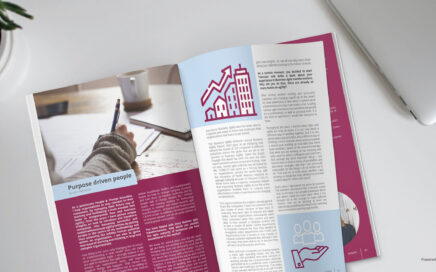
Purpose driven people

Interview with Alize Hofmeester: As a passionate People & Change Executive, I help organizations to stay relevant to their customers, by reshaping their future way of working and facilitating a fresh mindset that leads to companywide flow and business agility. Over the years I have gained unique insights on how to introduce and transform companies into becoming successful and sustainable business-agility entities.

Continue reading

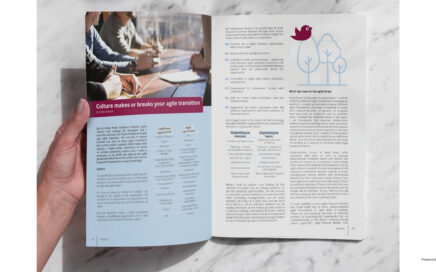
Culture makes or breaks your agile transition

We all know Peter Drucker’s famous quote ‘Culture eats strategy for breakfast’ and I transformed that into ‘Culture makes or breaks your agile transition’. For me this is reason number one why so many agile transitions fail. In this article I explain what I mean with culture, I make some references to books or articles explaining culture and I make a reference to my Bird’s eye view on the agile forest and elaborate on the, what I call, culture targeted frameworks or ways of working.

Continue reading
Use discomfort to learn forward in a continuous dialogue

Use discomfort to learn forward in a continuous dialogue

Agile working is developed to face complex problems in a VUCA (Volatile, Uncertain, Complex, Ambiguous) context. Agility helps to anticipate and adjust to changes while keeping the purpose ahead. The Agile way of working stimulates us to use all talents and perspectives in our team, which enables us to solve complex problems. When things go well, people experience work-energy and flow.

Continue reading
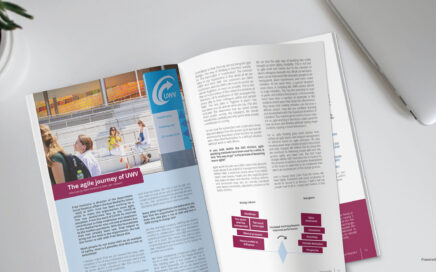
The agile journey of UWV

The agile journey of UWV

Fred Hoekstra is director of the department Social Medical Affairs (Sociaal Medische Zaken – SMZ) at UWV. Fred has been working for a while to make the organization more agile. This has accelerated due to the COVID-19 situation. From the start of COVID-19, UWV has contributed to help employees and employers in the Netherlands who ran into problems due to the sudden pandemic. With the foundations that had already been laid, Fred helped to bring out the best in the organization.

Continue reading
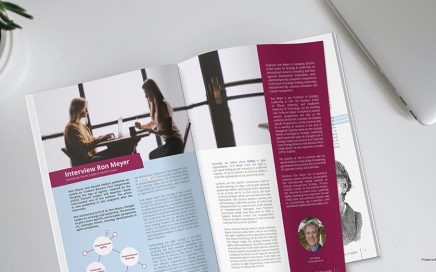
Strategy and leadership, an interview with Ron Meyer

Strategy and leadership, an interview with Ron Meyer

Ron Meyer and Ronald Meijers published an article on ‘Leaders Beware: Four Megatrends Shaping the Age of Agility’. Inspired by the  article Vincent Snijder and Maarten Leeuw interviewed one of the authors. They reached out to Prof. dr. Ron Meyer, thought leader on strategy and leadership. The aim was to get a more specific and broader perspective on, amongst others, strategy development in agile companies.

Continue reading

An agile journey is like sailing around the world

The leadership purpose of one of the Inspinity partners is ‘leading the expedition into unchartered territories and enjoying the journey more than the destination’. This contains two important elements that characterize every agile journey; it will be different than planned and it must be pleasant.

Continue reading
Myths

Agillusions: 10 myths on agile

So much has been said about agile. We thought it would also be good to show you the almighty myths of the corridor chat. Here are some statements that you should definitely question! Let us enlighten you why…

Continue reading
Innovation for relevance

Innovate to stay relevant

An important driver for organizations to become an agile organization is the need to cope with fast changing external circumstances. This can be anything like new technology, new eco-platforms, new legislation, new competitor products etcetera. This implies that innovation is a key element in the strategy.

Continue reading

Life Cycle Management value vs business value

Delivering business value is often seen as the holy grail for agile teams or agile organisations. Although true in itself but if the price for fixation on business value is that prioritisation for Life Cycle Management pays the price for that, you are putting your organisation at risk.

Continue reading

In love with agile

Valentine’s Day, every year it keeps many people busy. A large imaginary pink cloud is pouring out across the world for a euphoric peak around the thought that love overcomes everything.

Continue reading

Silo busting – do or die

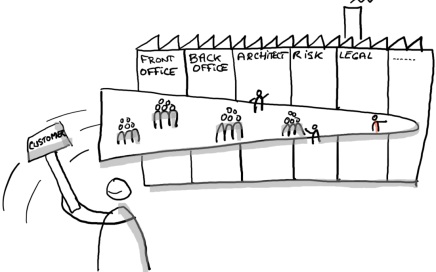
Old school organisations with traditional silo’s as Front Office/Mid Office/Back Office/IT/Risk…. will die. Like the dinosaurs they cannot adapt quick enough to changing circumstances. The solution for that are multi-disciplined teams where all relevant disciplines are represented. But is this also a realistic scenario for large organisations with hundred or even thousands of teams? In this article some best practices are shared on this leading to the answer ‘yes, that is possible’, even in large organisations.

Continue reading

Agilize the support functions too

A lot of organizations by now recognize the benefits of working in multi-disciplined BusDevOps teams. Teams where IT engineers closely collaborate with business oriented colleagues coming from Product Management for instance. We recognize the fact that these teams are much better equipped to deliver products and services that customers really want. Do the right things and do the things right.

Continue reading

No delayering, No agility

Many organisations are transforming into agile organisations nowadays. This is often born out of necessity to be able to cope with fast changes in the context of the organisation. In order to be able to quickly adapt to those changing circumstances a transformation is started where multi-disciplined teams are the foundation of the delivery organisation. For large organisations the concept […]

Continue reading

Agile Delivery Organizations are the Dream of Programme Managers

There was a time when programme management was regarded as an instrument of the non-agile world. This has caused a lot of uncertainty and a negative perception of agile ways-of-working in the professional community of programme managers. Programme managers could rightfully not understand how some of the complex change programmes they were working on could be handled without proper orchestration.

Continue reading

The Power of Aligned Autonomous Teams

Working in a Lean/Agile way of working is not new anymore for a lot of organizations. Many best practices are available showing examples how the organization can benefit from working in an agile manner. But many of the bigger organizations with a potential of hundreds of autonomous teams struggle with the question how to scale the agile way of working in such a way that it works in their context. This article describes the concept of Aligned Autonomy as a way to help big organizations to fully benefit from agile ways of working.

Continue reading